
What Is Claude Duet
Proactive, not reactive
It comes to you with what needs attention instead of waiting for a prompt.
Runs in the cloud
Its own private cloud computer keeps working when your laptop is closed.
Shares your Claude context
Memory, skills and connected apps carry over from your Claude account.
Claude Duet is a proactive AI agent from Anthropic. You hand it tasks by text or voice, it works on them in its own cloud computer, and it messages you when the work is done or when it needs a decision from you. Each morning it also sends a short brief on what needs your attention across your inbox, calendar and connected apps.
That one sentence hides a real change in how you use Claude. This explainer covers what Claude Duet is, how it works step by step, how it differs from the Claude chat you already know, what a normal day with it looks like, and what it deliberately does not do yet.
Updated October 22, 2026
Claude Duet defined: an agent that comes to you
Anthropic opened Claude Duet as a research preview on October 21, 2026. Its own description is short: Duet is "a proactive agent that understands what needs your attention." It is a separate app from the main Claude app, but it signs in with the same Claude account and is built on the same model family. At launch it runs on Opus 5.5.
The key word is proactive. Every assistant you have used so far, including Claude chat and Claude Cowork, is reactive: it does nothing until you open it and type. Claude Duet works the other way round. It checks the apps you connect every few hours, decides what matters, prepares the next step, and then reaches out with a notification. You are still the one who approves anything important, but you are no longer the one who has to notice everything.
Research preview since Oct 21, 2026
Research preview means early. Access is by waitlist, limited to Claude Pro and Max subscribers in the United States, and Anthropic says plainly that Duet "can still misjudge what's urgent." Team and Enterprise plans are not included yet. Our waitlist guide covers how to get in, and the availability tracker shows where it works today.
Built on Opus 5.5
Duet uses Opus 5.5, Anthropic's most capable general model at launch. That matters because a proactive agent has to make judgment calls all day: which email is urgent, which meeting conflict is real, whether a late invoice is worth a nudge. Anthropic frames the whole product around that idea; one section of its product page is titled "Built for judgment."
How Claude Duet works from message to finished task
Under the friendly chat thread, Claude Duet has three moving parts: a conversation with you, a computer of its own, and a schedule of check-ins.
- You send a message (or Duet sends one first). You can type or talk. There is no setup wizard: your Claude memory, skills and connected apps are available from the first message, and your whole history stays in one thread.
- Duet works in its own cloud computer. The work happens on a private cloud computer, not on your phone or laptop. That is why your laptop can be closed while it runs. Logins, approvals and safety checks also happen inside that environment.
- It reports back with finished work. Results come back as real files: docs, sheets, decks, dashboards or drafted replies. If a step needs you, for example sending an email or paying a bill, it stops and asks first.
- It keeps watching between tasks. Every few hours Duet checks your connected accounts. If something needs you, it messages you; if not, it stays quiet until the next morning brief.
Text or voice
Because Duet lives on your phone, voice is a first-class input. You can hand off a task while walking between meetings and read the result later at a desk on claude.ai.
Own cloud computer
The cloud computer is also why Duet cannot run "locally". Your data passes through Anthropic's cloud processing. If that is a concern, read the Claude Duet safety guide before connecting a work inbox.
Reports back when done
For larger jobs, such as scheduling a set of meetings or building a dashboard, Duet works in the background and messages you once it has finished, rather than making you watch progress.
How Claude Duet is different from Claude chat
If you already pay for Claude, the obvious question is why you would want a second app. Anthropic's own answer is that Duet uses your Claude account but "comes to you" with a morning brief and task updates, instead of waiting for you to open a chat. Here is the difference in practice:
| Claude chat | Claude Duet | |
|---|---|---|
| Who starts | You, every time | Either of you; Duet can message first |
| Where work happens | In the conversation you are watching | On its own cloud computer, in the background |
| Watching your apps | Only when you ask | Checks connected apps every few hours |
| Daily rhythm | None | Morning brief plus alerts when something needs you |
| Conversation | Many separate chats | One continuous thread |
| Apps | Claude app on all platforms | Standalone iOS and Android apps, plus the web |
It starts the conversation
The morning brief is the clearest example. Claude chat has never sent you a message you did not ask for. Claude Duet does it every day by design. Read the morning brief guide to see what it contains and how to tune it.
Same memory and skills
Nothing has to be re-taught. Duet picks up the memory, skills and connected apps already on your Claude account, which is why Anthropic says there is little setup.
One continuous thread
Instead of a sidebar of chats, Duet keeps one running conversation. That makes it feel more like texting an assistant than using a tool, and it lets the agent refer back to earlier tasks without you pasting context.
A day with Claude Duet
Anthropic's launch video follows a fictional owner of a coffee company called Clear Head Coffee Co. It is a demo, not a benchmark, but it shows the intended rhythm well:
Morning brief
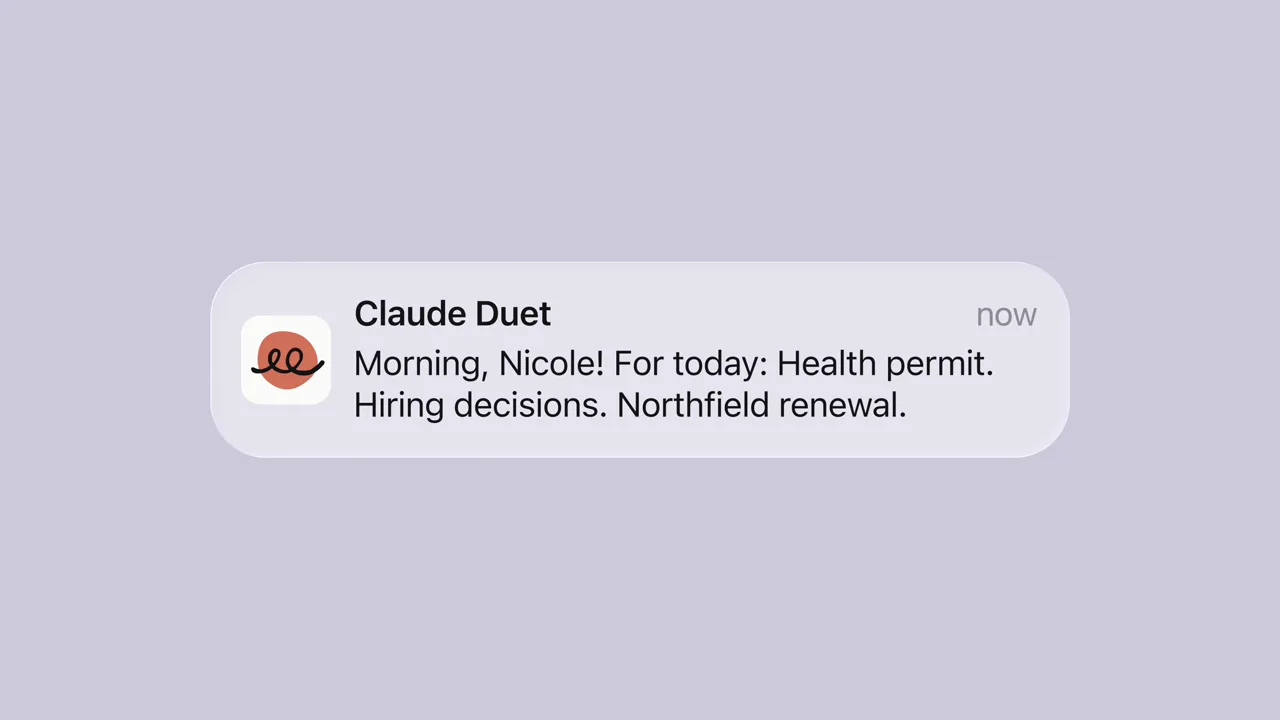
A push notification arrives: "Morning, Nicole! For today: Health permit. Hiring decisions. Northfield renewal." A daily dashboard pulled from point of sale, the online store, CRM, support, payroll and the bank has already refreshed at 5:30 a.m.
Midday alert
Duet notices that a new location opens in 26 days and no health permit has been filed. It drafts the permit and asks her to look it over and pay when she is ready.
Evening handoff
After a hiring panel finishes, Duet gathers the panel notes, summarizes the three finalists, and drafts an offer email with the package attached. The email waits behind "Not now" and "Send" until she taps Send. Later the agent reports back that the candidate signed. Our use cases page turns that story into twelve jobs you can hand off yourself.
What Claude Duet is not (yet)
It helps to be clear about the limits before you join the waitlist.
Not autonomous for sensitive actions
Duet will not send a message, make a payment, sign a document or delete a file without your approval. That is a design choice, not a missing feature.
Not local
There is no on-device mode, and in the preview you cannot watch its browser while it works. You review its sources and the finished result instead.
Not for Team plans
Team and Enterprise workspaces are excluded at launch. If you use Claude through work, compare it with Claude Cowork, which is available on business plans.
Frequently asked questions
What is Claude Duet used for?
expand_more
Keeping on top of inbox, calendar and business apps without checking them yourself: a morning brief, alerts when something needs you, drafted replies, unpaid-invoice follow-ups, payroll prep for review, and reports, decks or dashboards built in the background.
Is Claude Duet a separate app from Claude?
expand_more
Yes. Claude Duet has its own iOS and Android apps and runs on the web at claude.ai, but it signs in with your existing Claude account and shares its memory, skills and connectors.
Does Claude Duet replace Claude chat?
expand_more
No. Claude chat is still where you ask questions and work through problems live. Duet is for things you want handled in the background and things you would otherwise have to notice yourself.
What model powers Claude Duet?
expand_more
Claude Duet runs on Opus 5.5 during the research preview.
Is Claude Duet an AI assistant or an agent?
expand_more
Both words fit, but agent is more accurate. Claude Duet takes actions in your connected apps on its own computer, while keeping sensitive actions behind your approval.
When did Claude Duet launch?
expand_more
Anthropic opened the Claude Duet research preview on October 21, 2026. See our launch recap.
Does Claude Duet remember my previous chats?
expand_more
It uses the memory on your Claude account, and everything you do with Duet stays in one continuous thread, so it can refer back to earlier tasks.
Can Claude Duet act without me?
expand_more
It can research, draft, organize and build on its own. It cannot send, pay, sign or delete without your explicit approval.
Is Claude Duet the same as Cowork?
expand_more
No. Cowork waits for you to brief it in the Claude app; Claude Duet watches your apps and comes to you. Read Claude Duet vs Cowork.
Who makes Claude Duet?
expand_more
Anthropic, the company behind Claude. This site is an independent guide and is not affiliated with Anthropic.